DBT & Communication
Why Do Follow-Up Questions Make Me Angry? Using DBT to Pause Before Reacting
You’re explaining something, and the other person asks a follow-up question. Suddenly, you feel irritated. Your voice sharpens, your body tightens, or you want to say, “I already explained that.”
Sometimes, a request for clarification feels like criticism, disbelief, or an interruption. The useful first step is noticing that reaction before choosing your response.
What might be happening?
Consider whether any of these descriptions fit:
- Feeling misunderstood: “I’m trying to explain myself, and it isn’t landing.”
- Feeling challenged: “Are they questioning whether I know what I’m talking about?”
- Losing your train of thought: “Now I have to stop and reorganize what I was saying.”
- Expecting immediate understanding: “They should understand what I mean already.”
These are possibilities to explore, not conclusions about you or the other person. Anger can be influenced by how we interpret an interaction, including whether we experience another person’s words as criticism. Source: NHS inform’s anger self-help guide.
A helpful distinction is: “They asked a question” is an observation. “They don’t respect me” is an interpretation.
The question might reflect curiosity, confusion, or disagreement. You can clarify its meaning without assuming the worst.
Use STOP before answering
STOP is a distress-tolerance skill from Dialectical Behavior Therapy, or DBT. It creates a pause between a strong emotion and an impulsive action. Source: Marsha M. Linehan’s DBT Skills Training Manual, distress tolerance teaching notes (PDF).
- S — Stop. Pause your reply. Let the person finish asking.
- T — Take a step back. Take a comfortable breath or ask for a brief moment.
- O — Observe. Notice tension, frustration, your interpretation of the question, and the urge to interrupt or defend yourself.
- P — Proceed mindfully. Choose a response that serves your goal: helping the other person understand.
You do not have to eliminate frustration before responding thoughtfully.
Try a sentence that keeps the conversation moving
Instead of “Why are you asking so many questions?” try:
“Which part would you like me to clarify?”
If you are losing your train of thought:
“Let me finish this thought, and then I can answer that.”
If you need a pause:
“Give me a moment to gather my thoughts.”
These phrases give you room to organize your response while leaving room for the other person’s questions.
Then use GIVE to support the relationship
GIVE is a DBT interpersonal-effectiveness skill focused on how you communicate:
- Be Gentle: Use respectful words and avoid accusations.
- Act Interested: Listen for what the person is actually asking.
- Validate: Acknowledge their need for clarity: “I can see why that part was confusing.”
- Use an Easy manner: Aim for a less tense, approachable tone.
Validation does not require agreeing with every interpretation. You can acknowledge someone’s perspective while explaining your own. Source: Marsha M. Linehan’s DBT Skills Training Manual, interpersonal effectiveness teaching notes (PDF).
Practice with our free Keystone visual
Pair this article with “STOP Before You React: When Questions Bring Up Frustration,” our Keystone visual covering STOP, helpful response phrases, and GIVE.
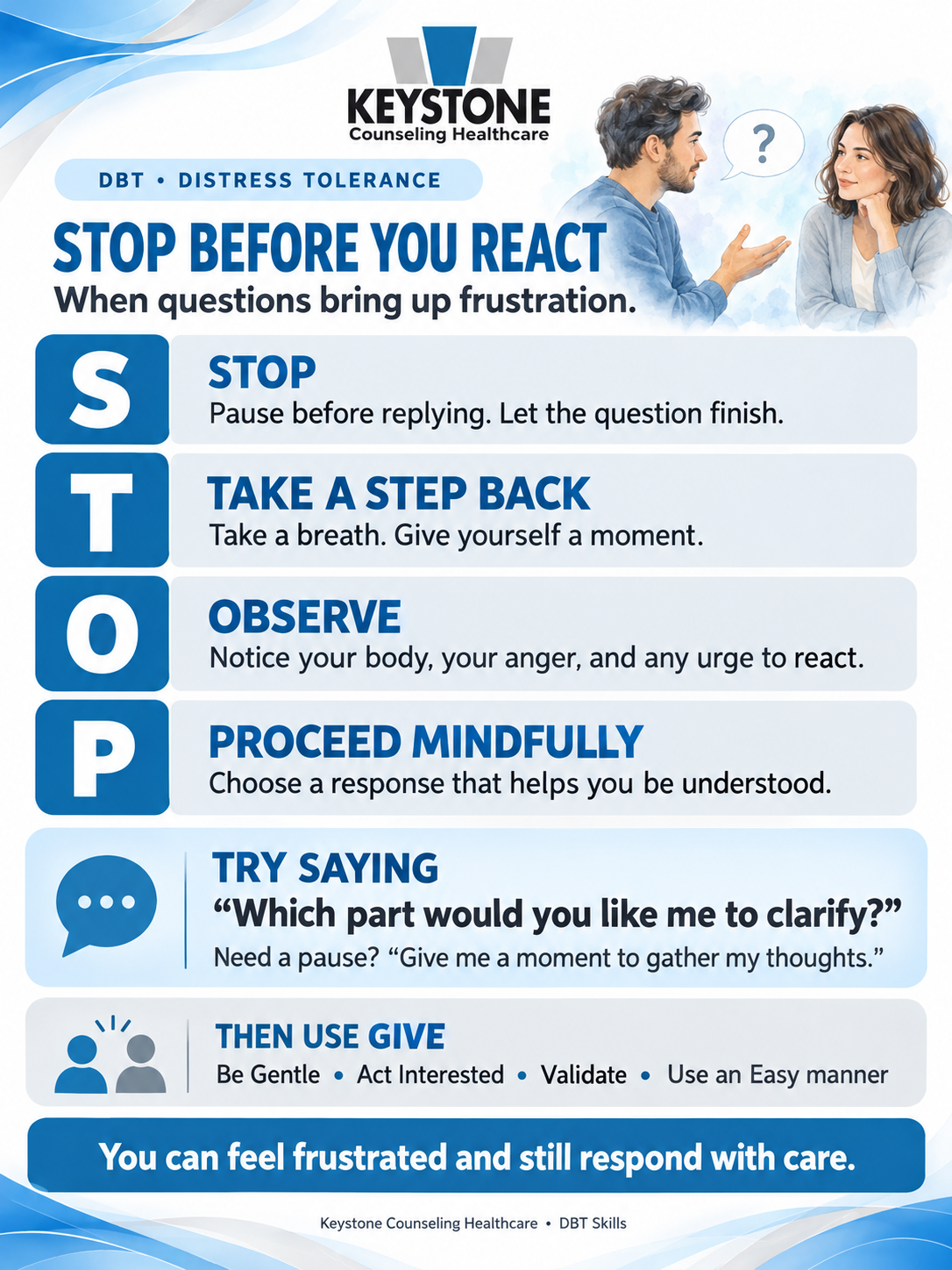
Review the visual before a conversation that may feel challenging. Choose one phrase to practice, then reflect afterward on what helped.
When additional support may help
If this pattern repeatedly affects conversations at home or work, therapy can provide space to identify triggers and practice different responses. Using one DBT skill is a starting point; it is not the same as participating in a full DBT treatment program.
For people seeking support in Boston, the South Shore, or elsewhere in Massachusetts, explore Keystone’s therapy approaches or Request an Appointment.
This article provides general education and does not replace individualized care.