Anxiety & CBT
Anxiety Therapy in Braintree, MA: How CBT Can Help
You replay a conversation and wonder whether you said something wrong. A brief message from your supervisor leaves you expecting bad news. Before an appointment, your mind runs through everything that could go wrong.
When these patterns become frequent, anxiety can take up time and energy you would rather spend elsewhere.
If you are looking for anxiety therapy in Braintree, MA, Cognitive Behavioral Therapy—usually called CBT—is one approach to explore. CBT is a research-supported treatment that helps people understand anxious thinking and change behaviors that keep worry going. The National Institute of Mental Health identifies CBT as a commonly used treatment for generalized anxiety disorder. Source: NIMH, generalized anxiety disorder.
1. How does CBT help with anxiety?
CBT examines connections among situations, thoughts, emotions, physical sensations, and actions.
Consider this illustrative example:
- Situation: Your supervisor asks to speak tomorrow.
- Thought: “I must have done something wrong.”
- Feeling and body response: Worry, tension, and a racing heart.
- Action: You repeatedly review your work and struggle to focus on anything else.
CBT can help you recognize the prediction, consider the available evidence, and choose a useful response. It also addresses what you do when anxiety appears, including avoidance. These connections between thoughts, feelings, and behavior are central to the CBT approach. Source: NHS, self-help CBT techniques.
The goal is a more accurate, flexible response. You can acknowledge uncertainty without assuming the worst.
2. What are automatic negative thoughts, or ANTs?
“ANTs” is a memorable shorthand for automatic negative thoughts: thoughts that appear quickly and may sound convincing before you have examined them.
Our Keystone visual introduces 12 thinking patterns to notice with curiosity:
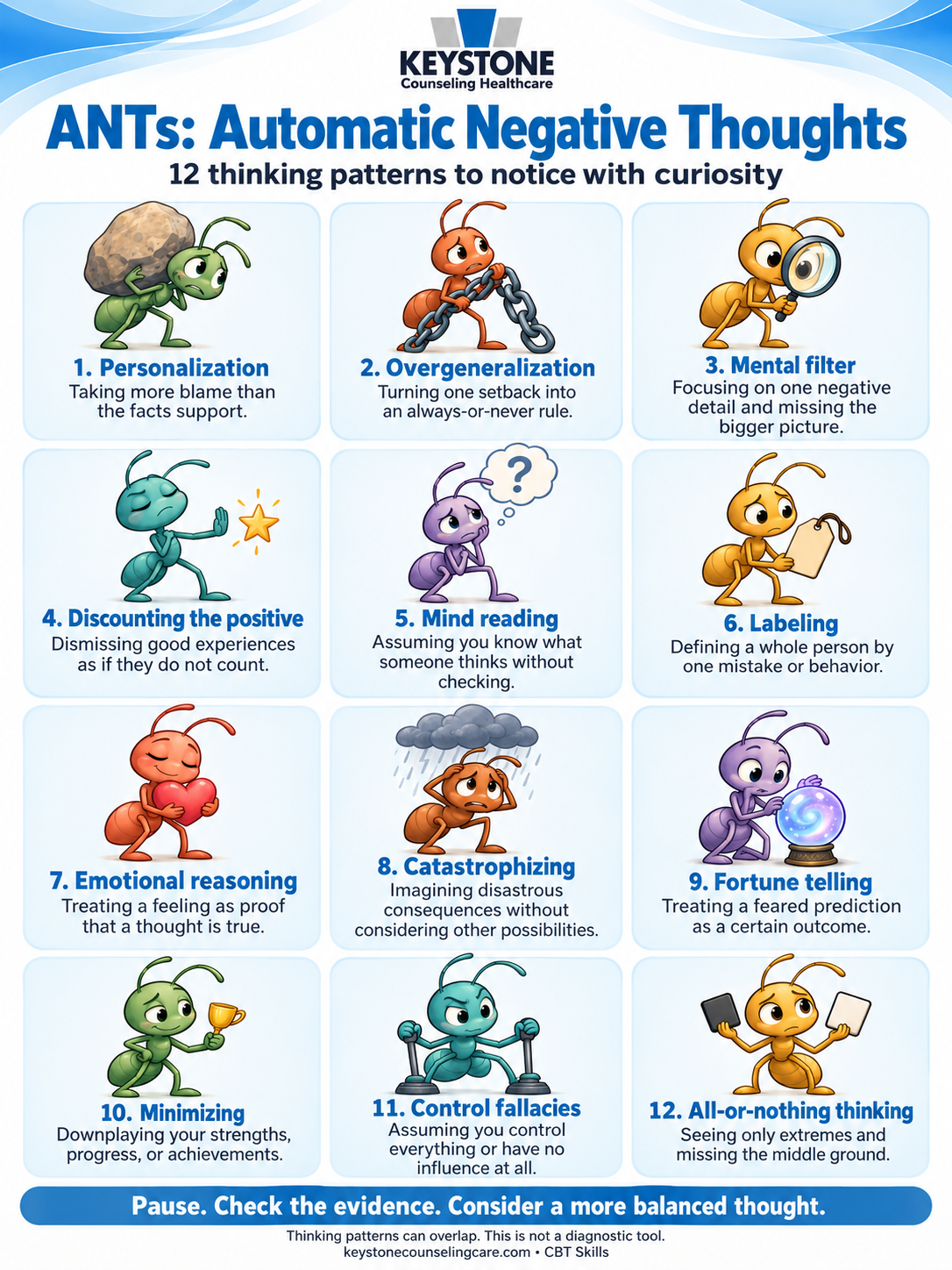
The patterns include personalization, overgeneralization, mental filtering, discounting the positive, mind reading, labeling, emotional reasoning, catastrophizing, fortune telling, minimizing, control fallacies, and all-or-nothing thinking.
These labels describe patterns to explore. They are not diagnoses, and having a negative thought does not automatically mean it is inaccurate. Difficult circumstances may call for problem-solving, support, or boundaries.
3. Which thinking patterns might show up with anxiety?
Here are four examples:
| Thinking pattern | Anxious thought | A more balanced response |
|---|---|---|
| Mind reading | “They think I’m incompetent.” | “I don’t know what they think. What have they actually said?” |
| Catastrophizing | “One mistake will ruin everything.” | “There may be a consequence. What is most likely, and how could I respond?” |
| Fortune telling | “The appointment will go badly.” | “I cannot know the outcome yet. I can prepare questions.” |
| Emotional reasoning | “I feel afraid, so something terrible must be happening.” | “My fear is real. I can also examine what is happening around me.” |
You do not need to identify the perfect label. Noticing “I’m treating a prediction as a fact” may be enough to begin.
4. What is a simple CBT exercise we can practice?
Try a brief thought record. The following example is educational, not a client story.
- Describe the situation. “A friend has not replied to my message.”
- Write the automatic thought. “They are upset with me.”
- Name the feeling. “I feel anxious and embarrassed.”
- Check the evidence. “There is no reply yet. They have not said they are upset.”
- Consider alternatives. “They could be busy, distracted, or deciding how to respond.”
- Choose a balanced thought and action. “I don’t know why they haven’t replied. I can return to my evening and decide later whether a follow-up is appropriate.”
CBT commonly includes questioning unhelpful thoughts, considering other perspectives, and practicing skills between sessions. A therapist can help adapt the exercise to your needs. Source: NHS, cognitive behavioural therapy.
Keep the exercise brief. If reviewing the evidence becomes another round of endless checking, bring that pattern to your therapist.
5. Does CBT involve more than changing thoughts?
Yes. Behavioral practice is an important part of CBT.
Avoiding something may bring immediate relief while making it harder to approach later. Depending on the concern, therapy may include gradually practicing feared but safe activities—for example, contributing a short comment during a meeting or making a necessary phone call.
Exposure-based work helps people approach fears and activities they have been avoiding. The plan should fit the particular anxiety problem and be developed collaboratively with a qualified clinician. Source: NHS, self-help CBT techniques. Source: NIH, anxiety disorders.
Progress can mean participating in something meaningful while some anxiety remains.
6. What should we expect from anxiety therapy?
An initial assessment explores your symptoms, goals, and how anxiety affects everyday life. Your clinician can help determine whether CBT or another approach fits your situation.
Sessions may involve reviewing recent situations, practicing a skill, and choosing manageable practice for the coming week. Treatment length varies; ask how you will review progress together. Source: NHS, cognitive behavioural therapy.
Useful goals might include spending less time replaying conversations, approaching activities you have avoided, or recovering more quickly after a stressful moment.
7. Can Braintree residents receive anxiety therapy online?
Online therapy may be an option for people living in Braintree and elsewhere in Massachusetts. NIMH notes that psychotherapy can be effective when delivered in person or through telehealth. The appropriate format depends on your needs and the clinician’s assessment. Source: NIMH, generalized anxiety disorder.
Ask Keystone about current clinician availability, Massachusetts telehealth options, fees, and insurance participation. Confirm any in-person office location directly.
Finding anxiety support for Braintree, MA
If worry, avoidance, or overthinking is interfering with your daily life, Request an Appointment with Keystone Counseling Healthcare. Share what you would like help with and ask about a clinician experienced in CBT for anxiety.
This article and visual provide general education. They do not diagnose an anxiety disorder or replace individualized assessment and treatment.